Free strength finder
Reading glasses strength chart.
And your own number.
As a rule of thumb, for a phone at 14 inches: +1.00 to +1.50 in your late 40s, +1.50 to +2.00 in your early 50s and about +2.25 from 55. A book needs a little less, a computer screen much less. Get the strength for your own distance in seconds, and fine-tune it in about a minute if you like.
- Free, no sign-up
- An answer in seconds
- Camera or your own distance
- Phone or computer
- Good light
- About 30 seconds
Strength chart by age
Reading glasses strength by age.
For a phone, a book and a screen.
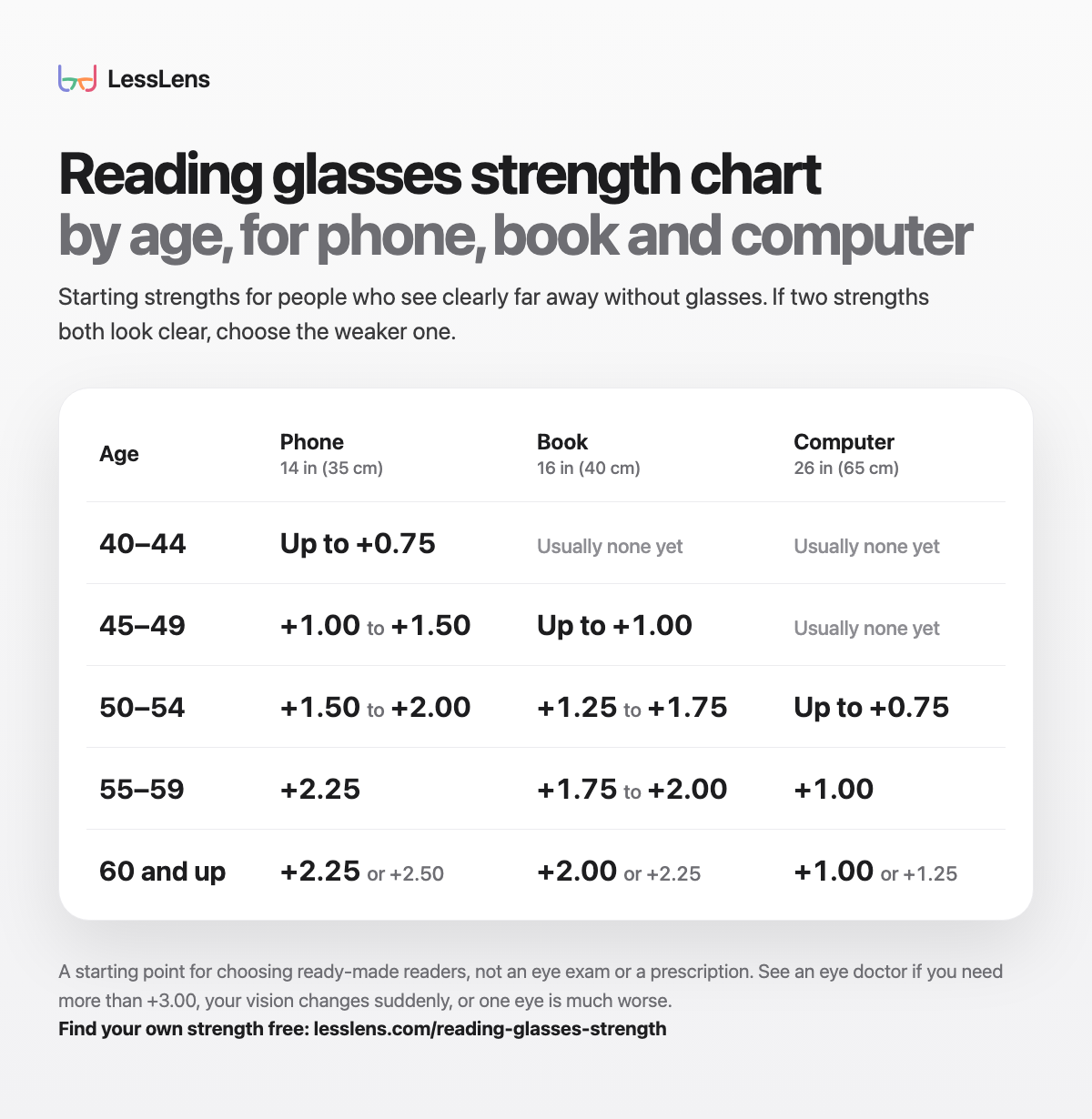
A place to start if you see clearly far away without glasses. The closer you hold things, the stronger the readers: a phone at 14 inches needs more than a book at 16, and a computer screen at 26 inches much less.
| Age | Phone14 in (35 cm) | Book16 in (40 cm) | Computer screen26 in (65 cm) |
|---|---|---|---|
| 40–44 | Up to +0.75 | Usually none yet | Usually none yet |
| 45–49 | +1.00 to +1.50 | Up to +1.00 | Usually none yet |
| 50–54 | +1.50 to +2.00 | +1.25 to +1.75 | Up to +0.75 |
| 55–59 | +2.25 | +1.75 to +2.00 | +1.00 |
| 60 and up | +2.25 or +2.50 | +2.00 or +2.25 | +1.00 or +1.25 |
How it’s worked out: the lower end of the usual focusing range at each age (Hofstetter’s formula), with half of it kept in reserve, a rule optometrists use for reading glasses (Goss). The finder starts from this chart at your own distance; its fine-tune uses the same rule with your own range. People of the same age can need strengths 0.25 to 0.50 apart, so treat this as a starting point. The American Academy of Ophthalmology suggests trying readers and choosing the strength that makes print clear at a comfortable distance.
Phone, book or screen
Closer means stronger.
One pair rarely suits all three.
- 14 inPhoneThe strongest of the three: a phone is often held closer than a book.
- 16 inBookThe usual distance for a book or magazine.
- 26 inComputer screenAbout 1.00 weaker than for a book, so a reading pair can make a screen blur.
Readers are sharpest over a short span of distances. A pair that suits a book often feels too strong for a computer screen, and a phone held close can ask for more. That’s why the finder gives you a strength for each.
What the numbers mean
What +1.50 means.
Where print is sharpest.
The number is the lens’s power in diopters: +1.00, +1.25, +1.50 and so on, in quarter steps. The higher the number, the closer the print it brings into focus.
If you see clearly far away, print is sharpest with no effort at 100 ÷ power centimeters: about 26 inches for +1.50, 20 inches for +2.00. Your eyes’ own focusing brings print a little closer from there.
- +1.0039 in · 100 cm
- +1.5026 in · 67 cm
- +2.0020 in · 50 cm
- +2.5016 in · 40 cm
- +3.0013 in · 33 cm
Where print is sharpest with no focusing effort, for eyes that see clearly far away.
How the finder works
How to find your strength.
Seconds, then a minute if you like.
-
01
A few questions.
Your age, and whether ready-made readers suit you. If they don’t, you’ll see what suits you instead, and what to do next.
-
02
Your reading distance.
Pick or type how far you read, or let the camera measure it. You get a starting strength for that distance right away.
-
03
Fine-tune if you like.
About a minute: bring your phone closer until the words blur, then away until they’re sharp. It’s offered mainly between about 42 and 55.
When to see an eye doctor
Readers aren’t a checkup.
See an eye doctor if…
Ready-made readers help healthy eyes see up close. They don’t check your eyes, and some changes need a doctor first. The American Academy of Ophthalmology suggests a baseline eye exam at 40.
-
You’re around 40
A baseline eye exam at 40 is worth having even if you see well, and readers can come after it.
-
Vision changes suddenly
Sudden blur, eye pain, flashes of light, new floaters, or double or distorted vision: see a doctor right away.
-
Diabetes or glaucoma
If you have diabetes, or glaucoma runs in your family, regular eye exams matter more than any readers.
-
You need over +3.00
If you need more than +3.00, or no strength makes print clear, see an eye doctor before buying readers.
-
Readers bring headaches
If reading with readers gives you headaches or tired eyes, have your eyes checked.
-
One eye is much worse
Ready-made readers have the same strength in both lenses, so eyes that differ need glasses made for them.
Ready-made or made for you
Ready-made readers,
or reading glasses made for you?
Ready-made readers suit you if
- Things far away are clear without glasses (contact lenses are fine).
- Both eyes see about the same.
- You’re past about 40, and small print has started to blur.
Ask an eye doctor for glasses made for you if
- You wear glasses for distance: you’ll need your prescription with an added strength for close up (the ADD), or progressive lenses.
- One eye differs from the other, or lines look doubled, wavy or tilted.
- You need more than +3.00.
Questions
Reading glasses strength,
answered.
Updated November 26, 2026. New to prescriptions? How to read your prescription. Buying new glasses? Measure your PD and find your frame size.
What strength reading glasses do I need?
As a rule of thumb, for a book at 16 inches: up to +1.00 in your late 40s, +1.25 to +1.75 in your early 50s and about +2.00 from 55; a little more for a phone and less for a computer screen. Your own number depends on where small print starts to blur for you. Pick the weakest strength that makes print sharp at the distance you read: the finder on this page works it out with your camera, or a distance you pick or type.
What happens if reading glasses are too strong?
You have to hold print closer than you’d like, things a little farther away blur, and some people get tired eyes or a headache. A pair that’s a little too weak usually feels better than one that’s a little too strong, which is why the finder says to choose the weaker of two strengths that both look clear.
Do I need different readers for my phone and my computer?
Often, yes. The closer you hold something, the stronger the readers it needs. A computer screen at about 26 inches usually needs about 1.00 less than a book at 16 inches, so a reading pair can make the screen blur. The finder gives a strength for each.
What does +1.50 mean on reading glasses?
It’s the lens’s power in diopters. For eyes that see clearly far away, print looks sharpest with no effort at about 26 inches (67 cm) through +1.50, and your eyes’ own focusing brings it a little closer. +2.00 brings that point to about 20 inches, +2.50 to about 16.
Can I find my reading glasses strength at home?
As a starting point, yes. The finder on this page asks your age, measures how far you hold your phone (or sit from your screen) with your camera, or takes a distance you pick or type, and gives the chart’s strength for that distance in seconds. To fine-tune it, take your readers off, bring small print slowly closer until it starts to blur, then away until it’s sharp again. It isn’t an eye exam and doesn’t check eye health.
How exact is an online strength finder?
It gives a strength to start with and the one next to it, not an exact answer for everyone: even in an eye doctor’s office, different methods can differ by 0.50 or more. If you can, try both strengths before you buy, and choose the weaker if both look clear.
Can I wear readers over contact lenses?
Yes. If your contact lenses make things far away clear, readers work over them the same way. Keep your contacts in when you use the finder. Monovision or multifocal contact lenses already cover reading, so ask your eye doctor before adding readers over them.
When should I see an eye doctor instead?
Around 40 for a baseline exam, and any time your vision changes suddenly, you see flashes or new floaters, things look doubled or distorted, you have diabetes or glaucoma in the family, one eye is much worse than the other, you need more than +3.00, or readers give you headaches.
Pick the frame
Found your strength?
Now pick the frame.
The strength is half the choice; the other half is a frame you like on your face. Try a frame style on with your camera in our live try-on demo, or try many more in the LessLens app on iPhone.
Run an eyewear store? See try-on for your store